Rapid Aging in an Emerging Cultural Hub
During the Hwayeon: Hongyeon-gil residency (Sep 2023 to Jan 2024), we observed rapid gentrification and the growth of cultural infrastructure. However, older residents were largely absent from these emerging cultural routes.
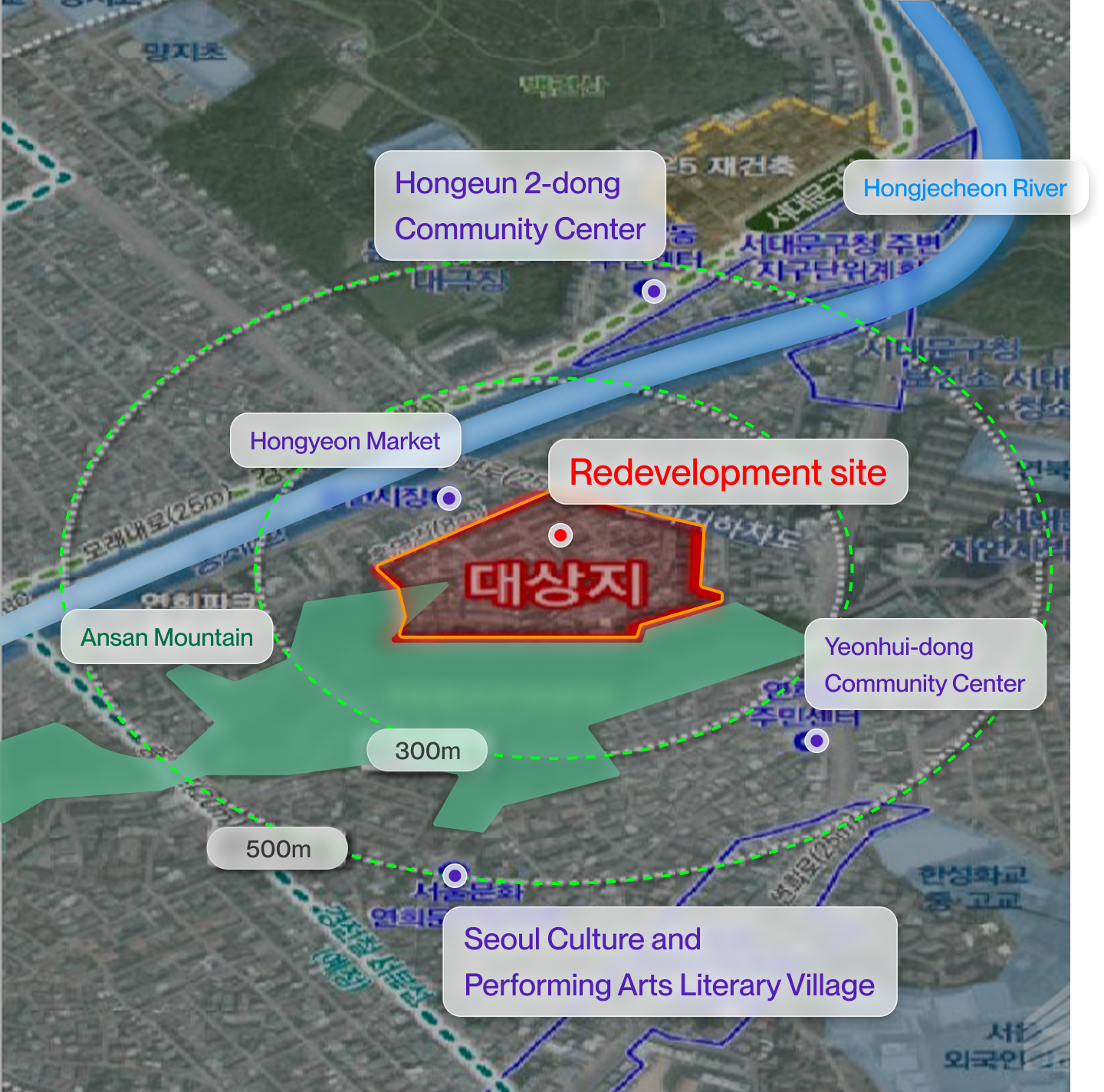
Aging is concentrated
236.8%
Aging Index
(Hongyeon-gil, 2021)
168.03%
Aging Index
(Seoul average)
Becoming a cultural hub
13
The number of Galleries
250
The number of Artists
(Yeonhui Art Fair, 2022)
The area is changing rapidly
49,745㎡
Public redevelopment area
1,094
Planned Housing Units
(Public Redevelopment Plan)
Cultural growth is accelerating, but older residents remain largely excluded from participation.
How we collected field insights
We mapped how younger residents describe Hongyeon-gil—and whether older adults appear in that narrative.
01. Research Process - Online Survey
Online Survey through Instagram
(Collaborated with Hongyeon-gil influencer, @hongyeongil_seoul)
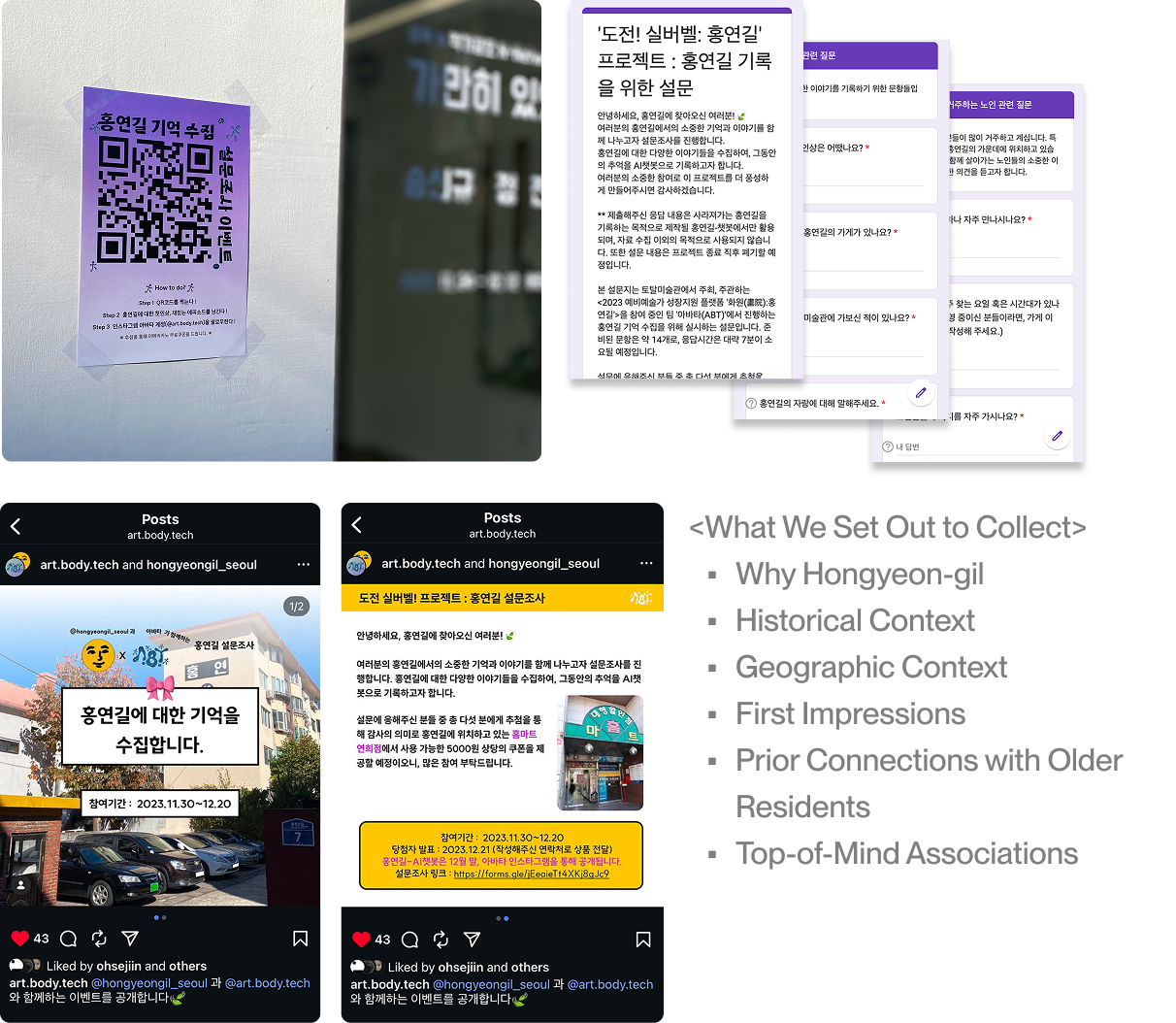
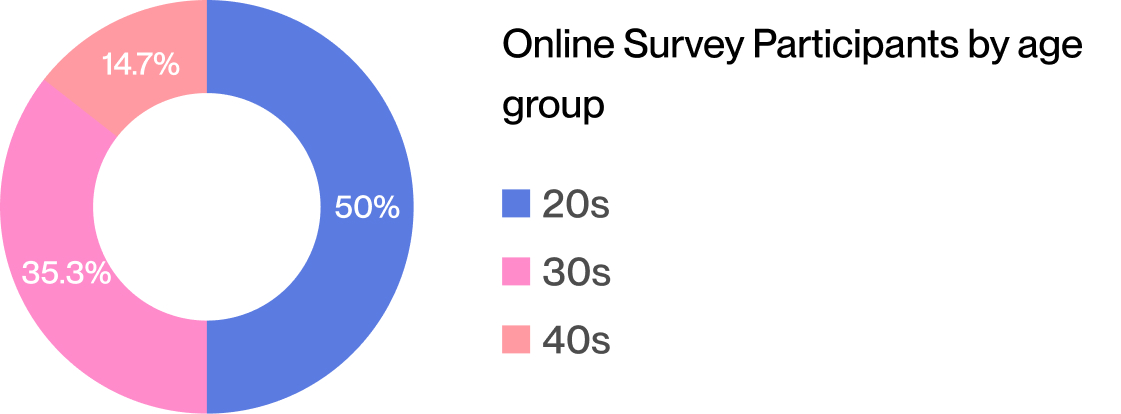
We used an online survey to capture local knowledge and how younger residents perceive older adults in Hongyeon-gil.
Survey Results
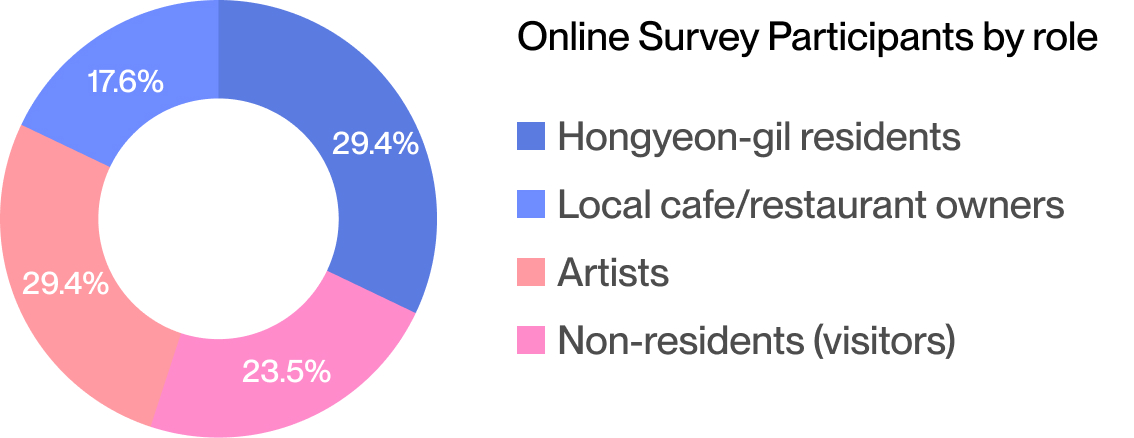
Participants : 34
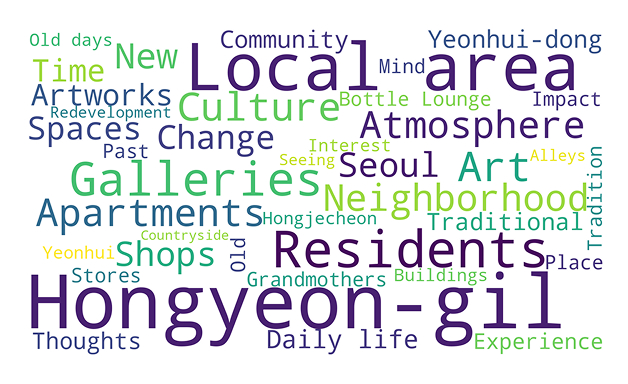
1. Older adults were rarely mentioned in how people described Hongyeon-gil.
Word cloud based on the response sheet
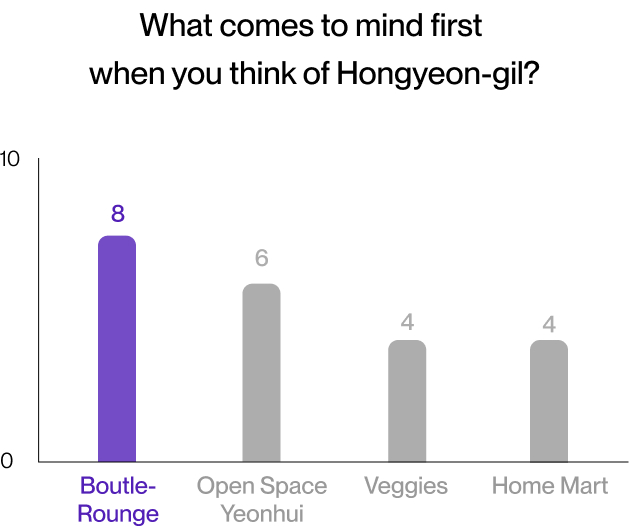
2. Hongyeon-gil is remembered through commercial leisure venues.
All top 4 venues are cafes and exhibition spaces in Hongyeon-gil.
02. Research Process - Interviews
Survey Results
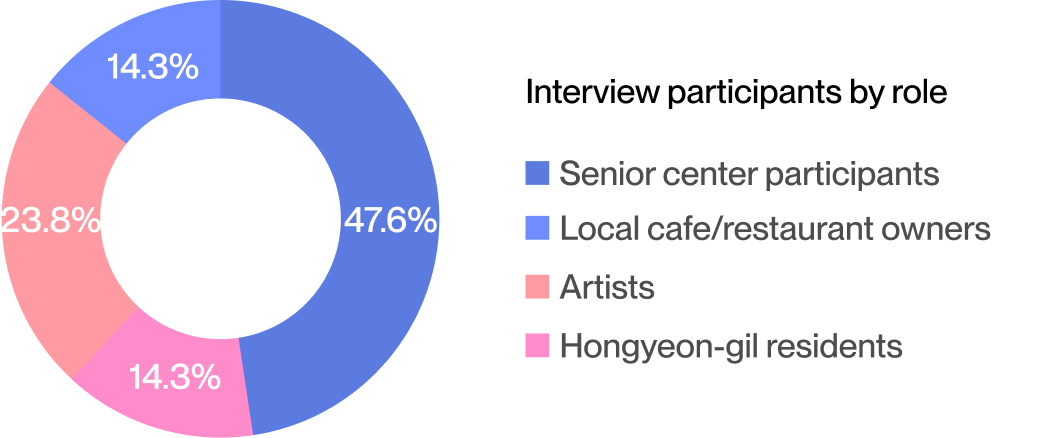
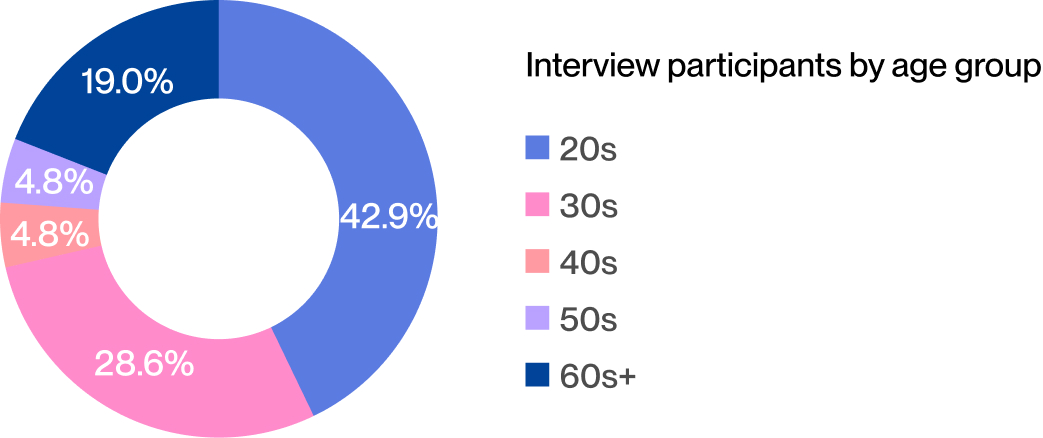
Participants : 42
We conducted in-person interviews to gather information about older adults who are not visible in online surveys.
Three Barriers in Everyday Routines
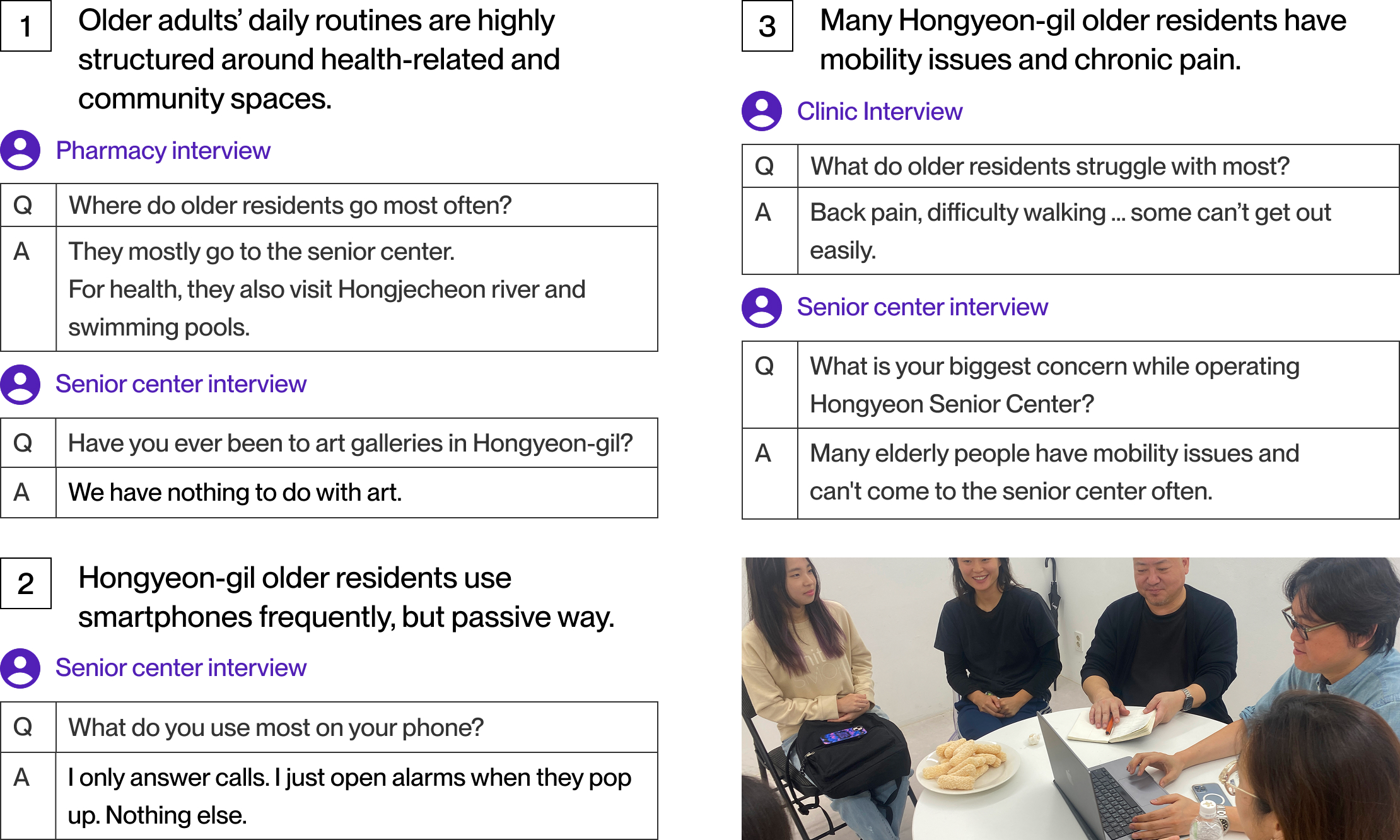
By combining the online survey (how people describe Hongyeon-gil) and offline interviews (how older adults live day-to-day), we identified three barriers that prevent older residents from participating—even when cultural infrastructure grows.
Older adults are absent from Hongyeon-gil’s mainstream narrative

The first elderly-related term appeared at rank 38 (“older adults”), and it was mentioned 12 times.

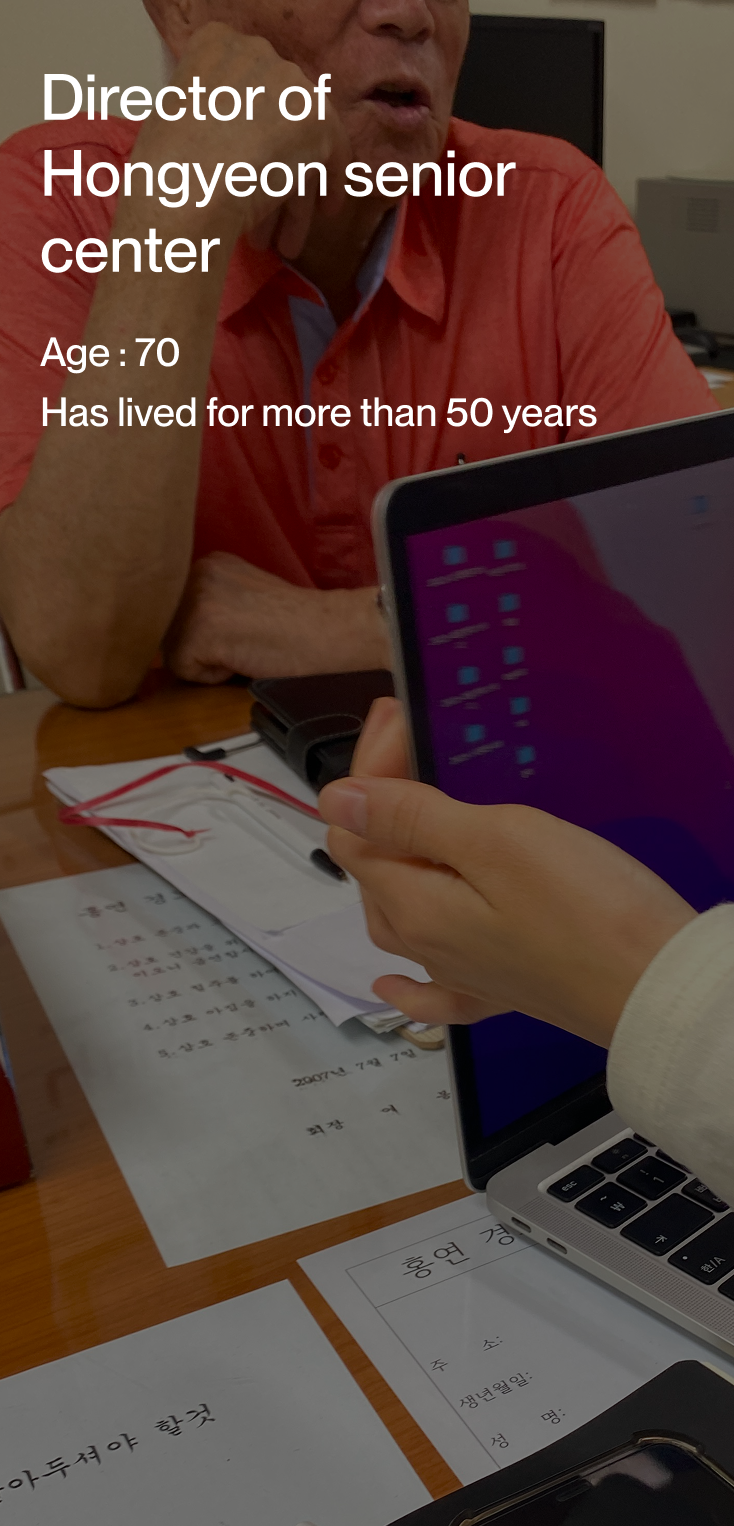
“I've never been to any galleries in Hongyeon-gil since I moved here in 1985. We have nothing to do with art." -Hongyeon senior center member A
Insights
Cultural infrastructure did not translate into perceived access for seniors.
“Going out” is a high-cost action
Hongyeon-gil is known for its cafés and galleries, but these aren't places seniors usually visit.
"Many elderly residents in Hongyeon-dong have mobility issues. The area has a lot of steep hills. Some seniors can't even make it here to Hongyeon Market where the hospital is located." -Director of Saecheonnyeon Clinic at Hongyeon Market
Insights
Participation must be home-based, low-effort, and safe for limited mobility.
The phone is reliable, but access is notification-led
"Many older adults spend time watching YouTube and short videos on their phones." -A Pharmacist who runs Hongyeon-Pharmacy
"I only use it for phone calls really, trying to learn bit by bit. I check messages, that's about it." -Hongyeon senior center member B
Insights
Design should be notification-first and delivered in familiar video-based cues.
Exercise initiation is the bottleneck
Interviews suggest barriers are less about motivation and more about effort, risk, and decision-making at the moment of starting.
Key Question
How can mobile interfaces reduce exercise initiation costs for older adults with limited mobility in everyday life?
What makes starting hard?
01. In Hongyeon-gil, steep hills make it difficult for older adults to reach exercise programs at senior centers or swimming pools.
02. Many older residents have limited mobility, which makes leaving home and moving around physically demanding.
03. Many older adults were unsure when to exercise or what kind of exercises to do.
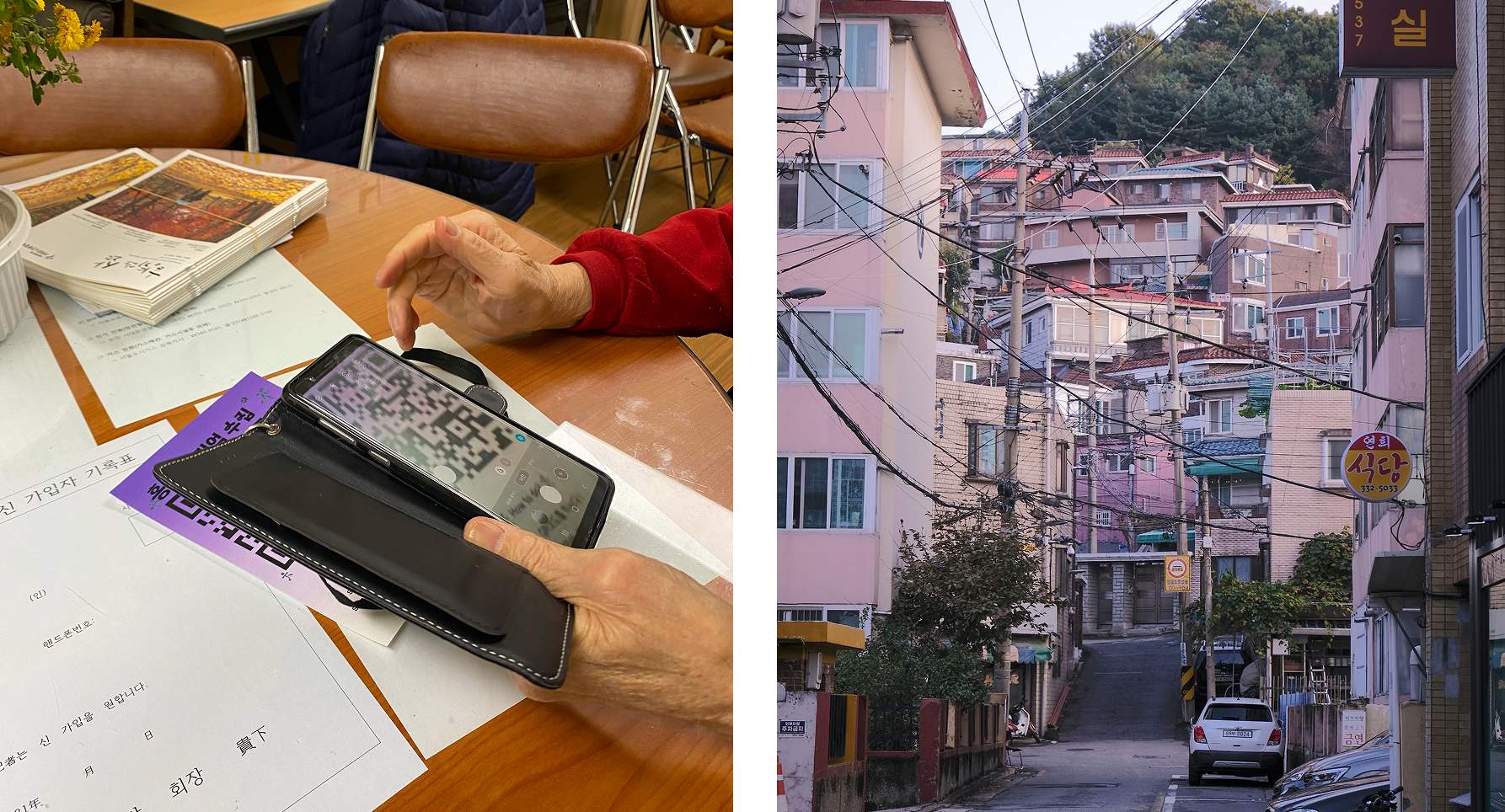
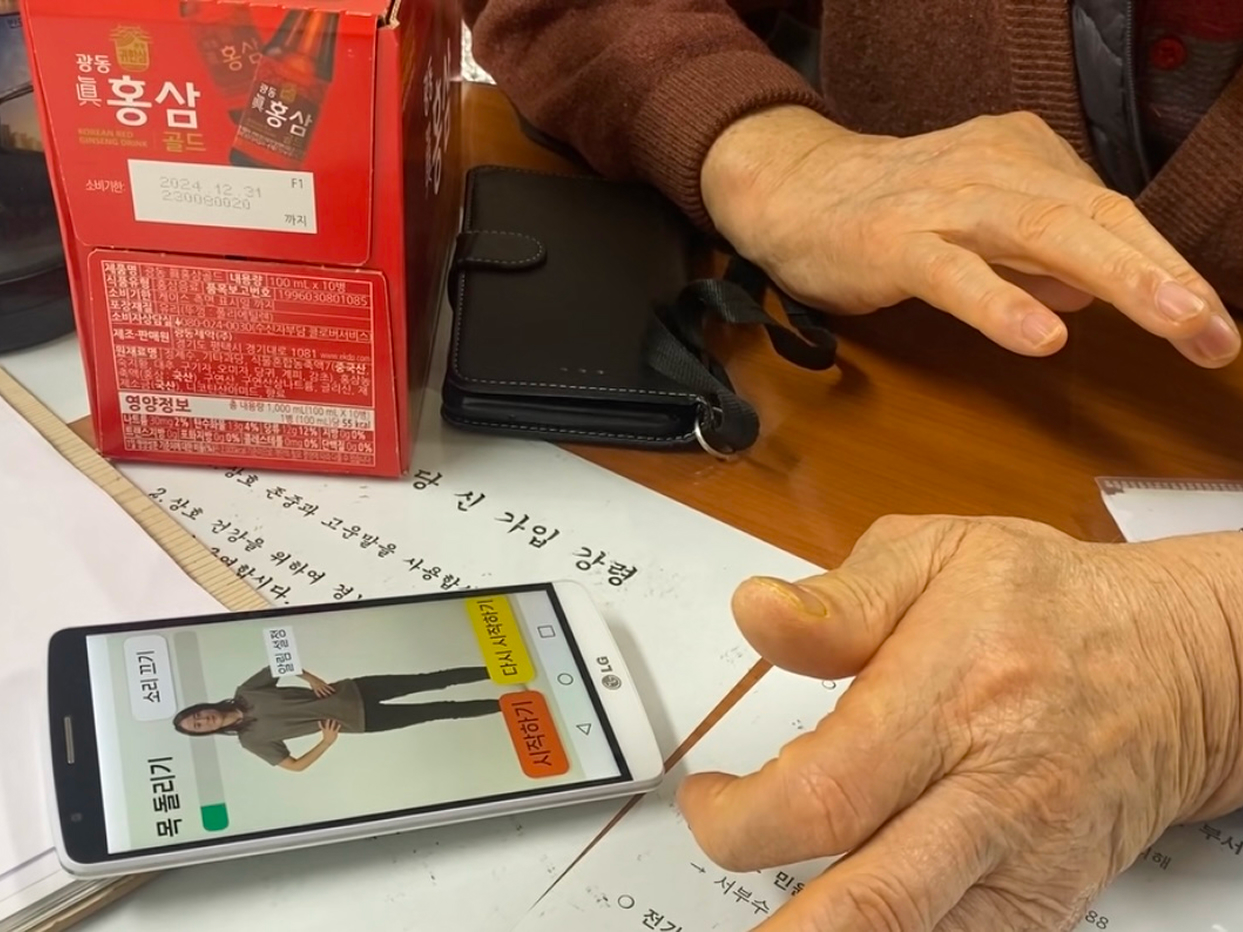
(left) An older resident in Hongyeon-gil explaining how he uses a smartphone. (right) A steep uphill street in Hongyeon-gil.
Three Key Principles for Reframing Participation
Based on field research, we reframed participation to reduce effort, risk, and decision-making.
Reducing the threshold of participation.

HOME-BASED PARTICIPATION
Participation can begin at the scale of the body, without leaving home.
Finding the most safe and familiar movement of the body.

FAMILIAR MOVEMENTS
Among bodily practices, repetitive, familiar movements minimize cognitive and physical load.
Finding the medium where bodily practice begins.

SEND NOTIFICATIONS
For participation to occur, initiation must not rely on intention, but be triggered externally.
Exercise Routine Design
To inform the exercise design, we consulted the pharmacist and the physician in Hongyeon-gil again.
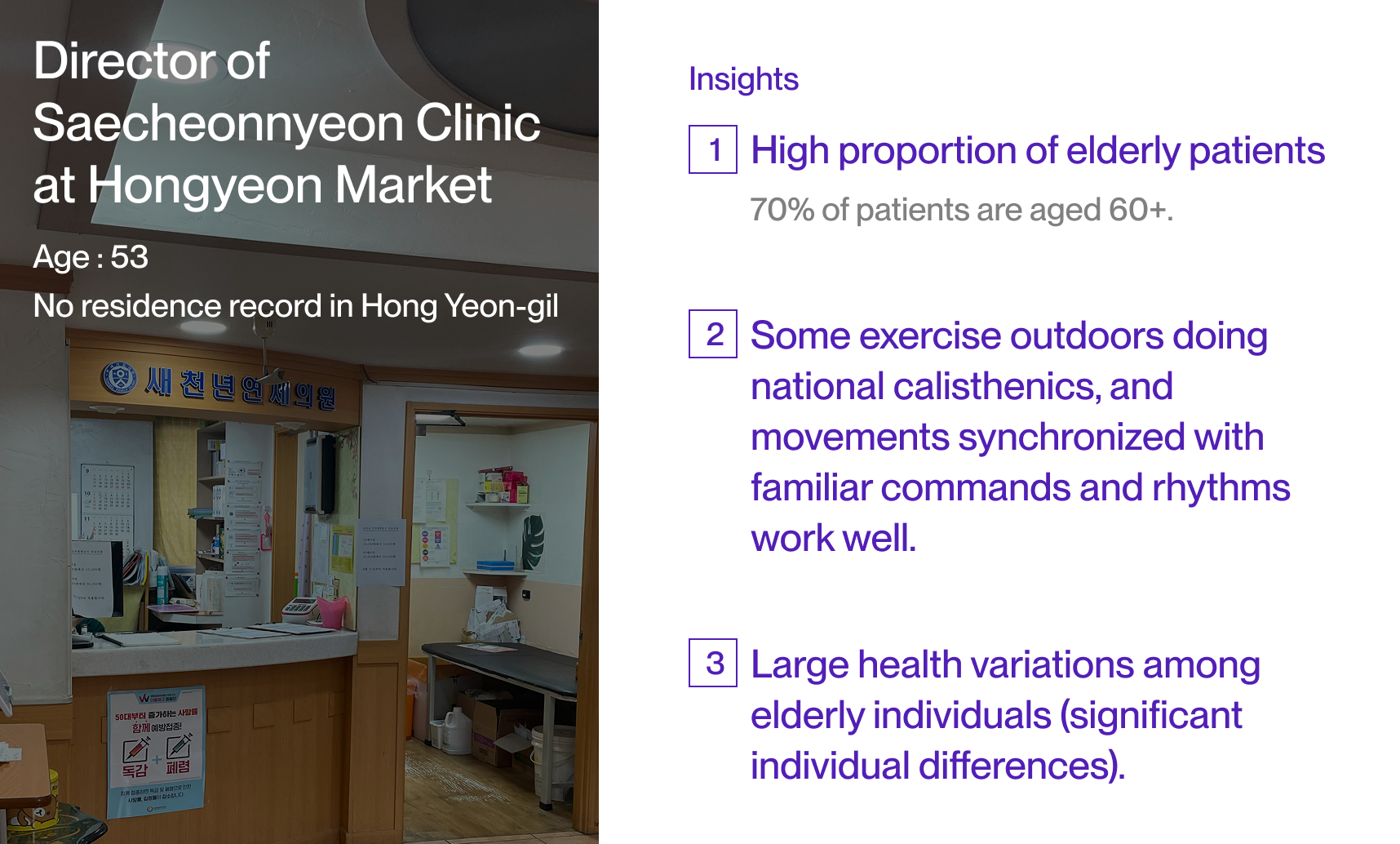
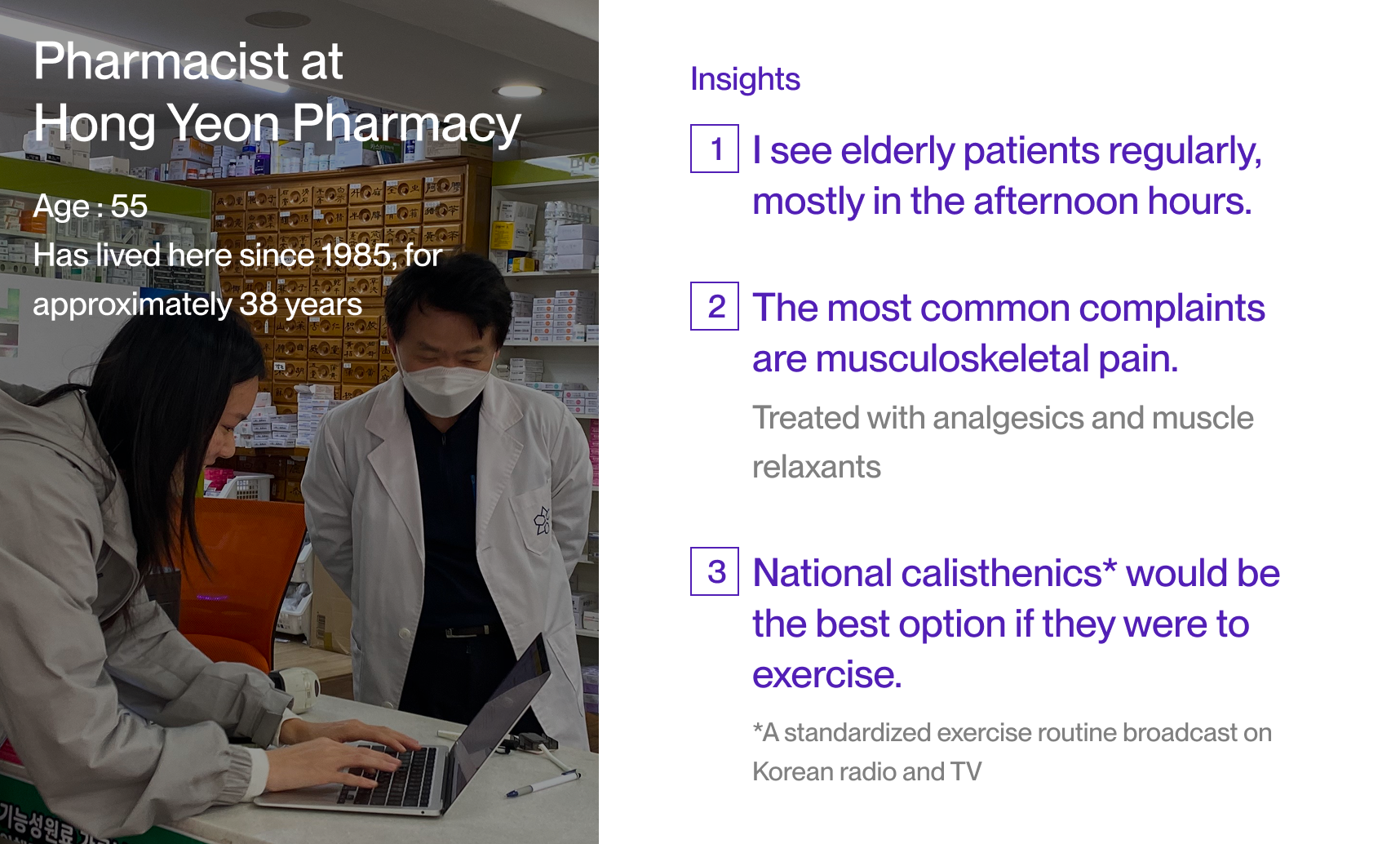
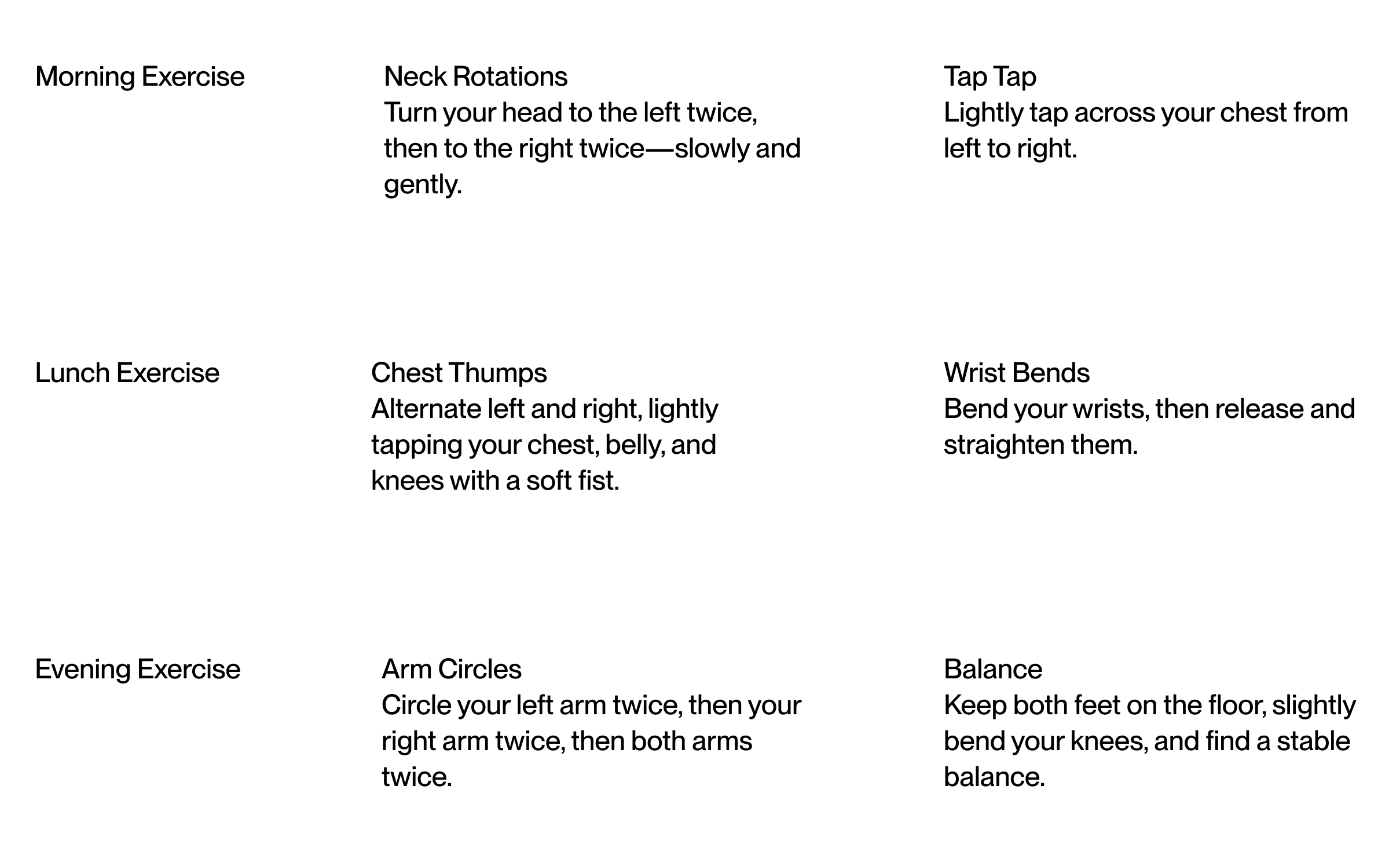
Design low-intensity exercises based on familiar routines like national calisthenics, accounting for individual differences rather than introducing new movements.
Notification-first Morning Exercise at Home
Interviews indicate that notifications are a primary entry point for older adults’ smartphone use.
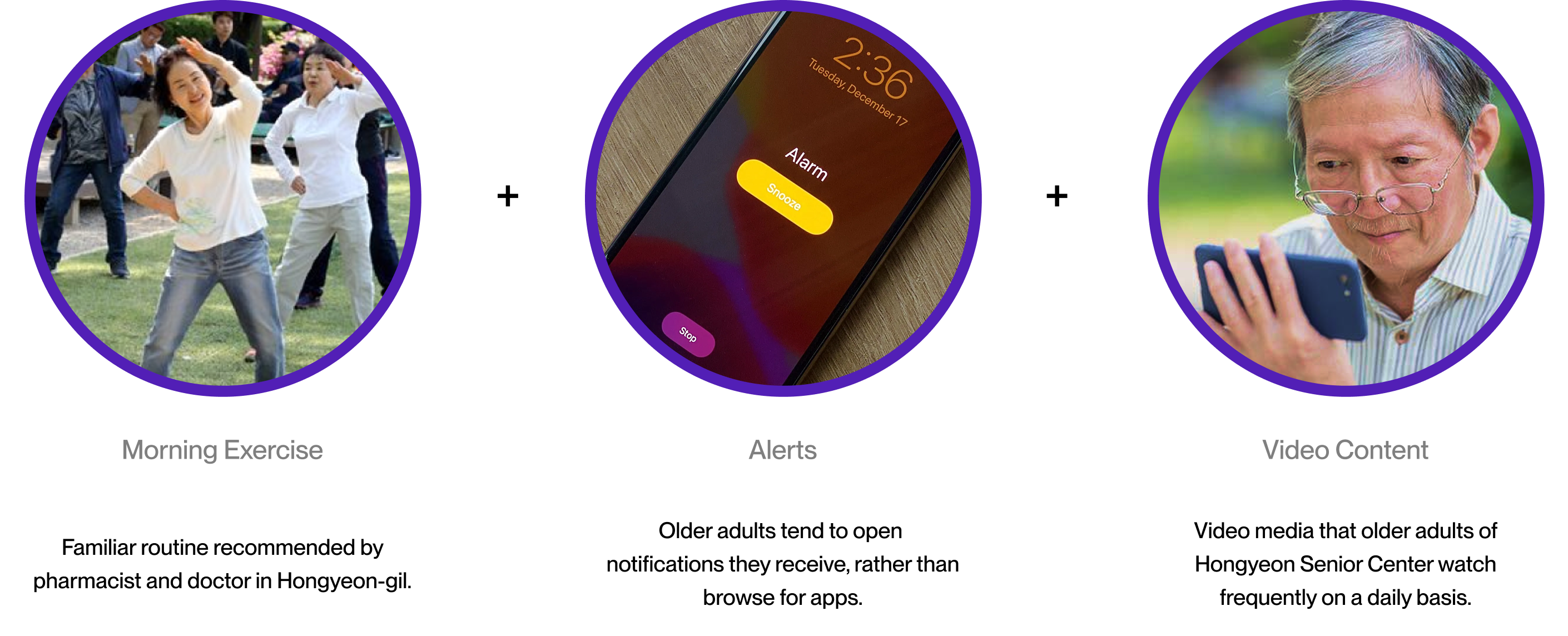
We designed a morning exercise experience that starts the moment older adults tap a notification.
By combining familiar routines with instant video playback, we reduce browsing and decision-making before exercise.
Familiar & Readable UI for Hongyeon-gil Seniors
Make the interface instantly recognizable and readable for Hongyeon-gil older adults.
01. Interaction Design
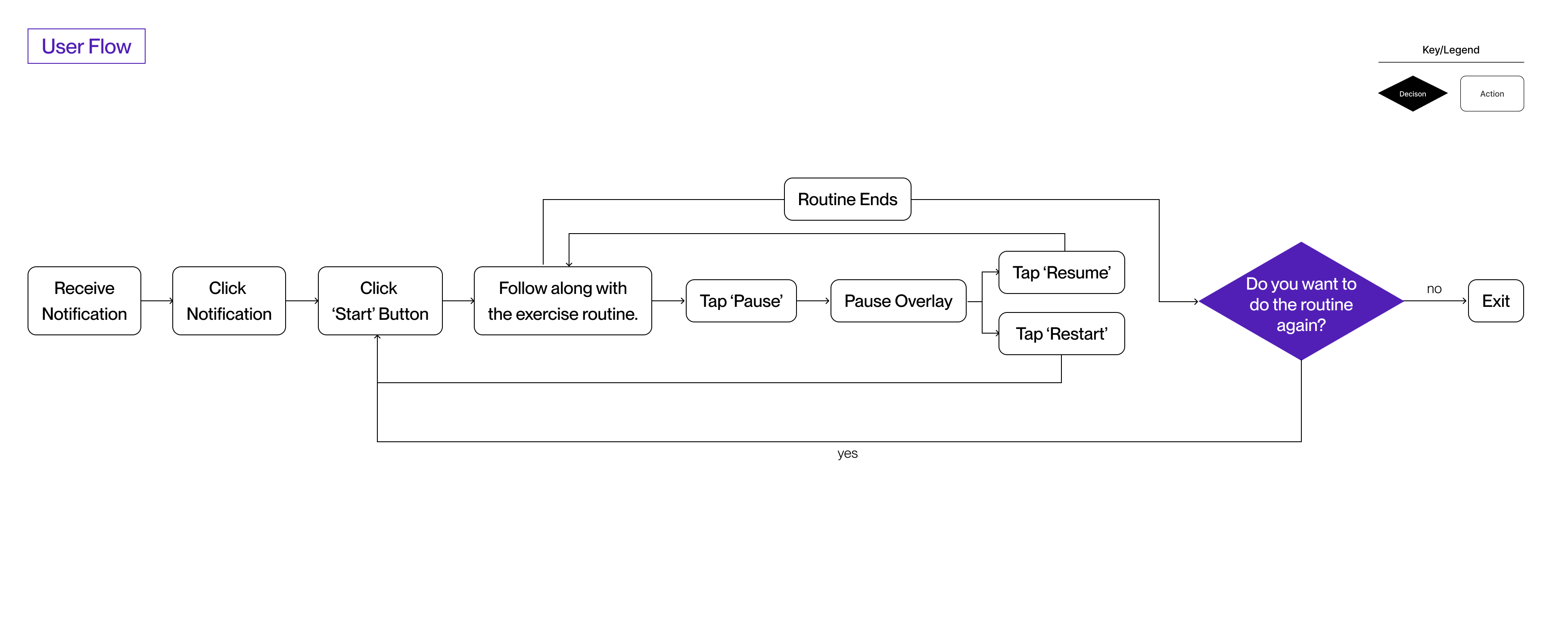
Exercise Routine Design
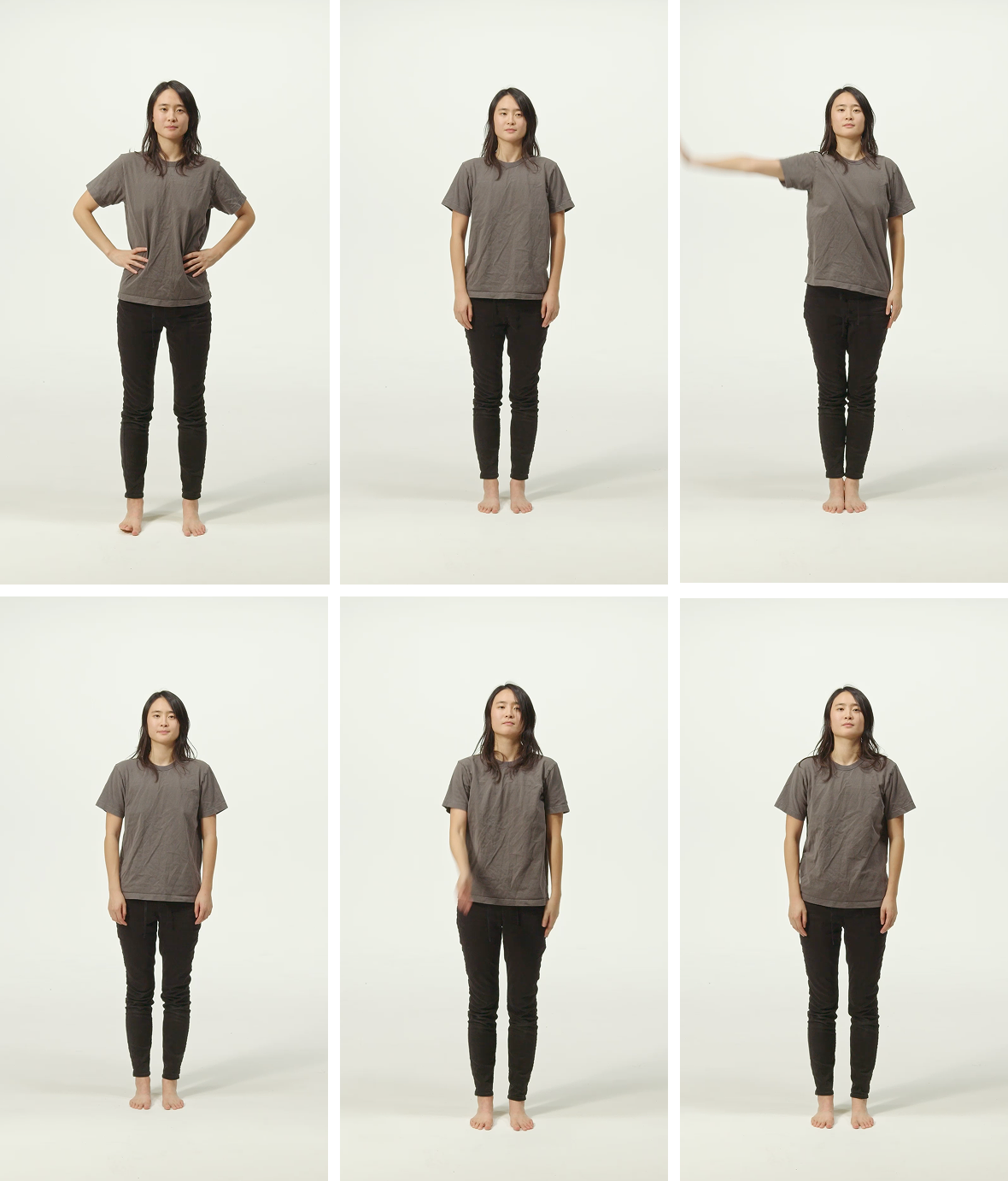
Create a familiar, safe routine older adults can follow without learning new moves.
02. Collaborated with a dance specialist
Notification Time Planning
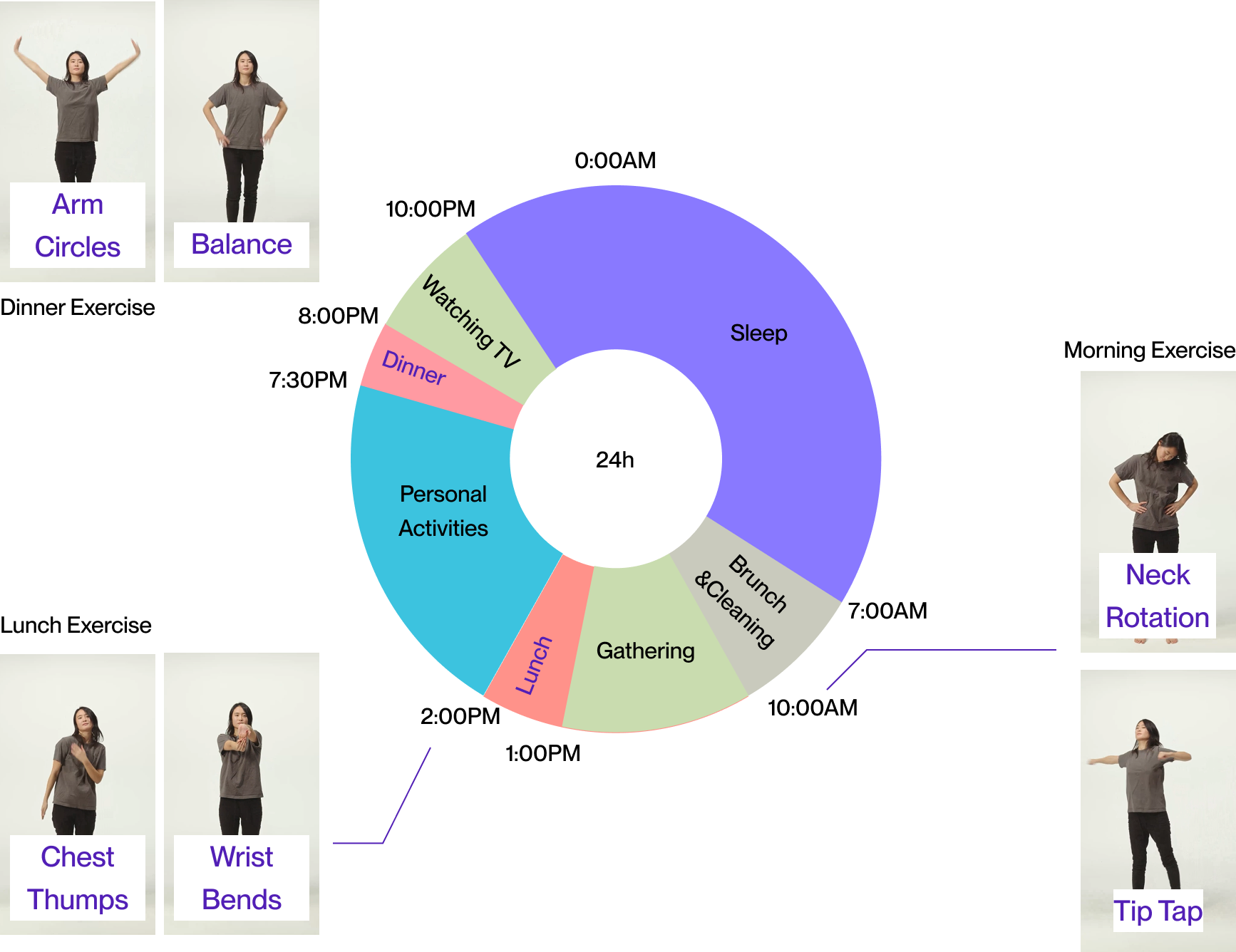
Send notifications at times when older adults are most likely to notice and act.
Insights
01. Morning Exercise : 10:00AM - 11:00AM
02. Lunch Exercise : 2:00 PM
Senior center lunch typically ends around 1:00 PM
03. Evening Exercise : 8:00 PM
Dinner is usually around 7:30 PM, and many go to bed soon after—so a reminder near the end of the evening routine works best s
Familiar & Readable UI for Hongyeon-gil Seniors
Make the interface instantly recognizable and readable for Hongyeon-gil older adults.
03. Color of accessibility for seniors
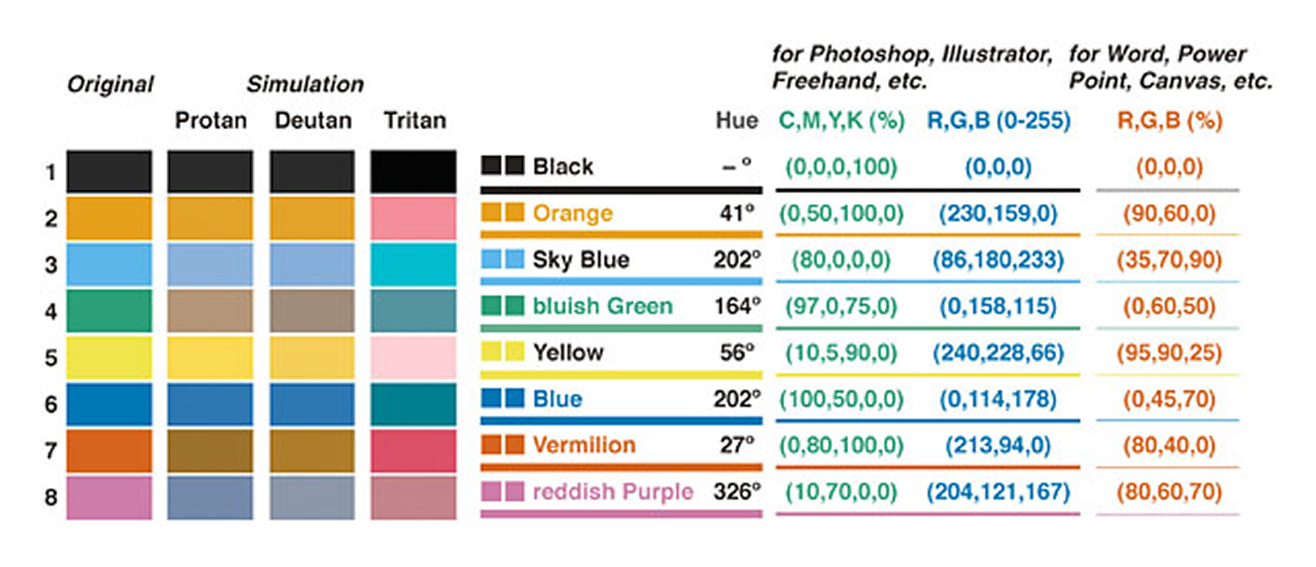
Following the guidelines of the <Color Universal Design Organization research> by Okabe Masataka and Ito Kei, we initially developed our color palette based on the color chart below, which ensures that people with color vision deficiency can clearly distinguish the colors.

This color chart represents the colors used in the UI.
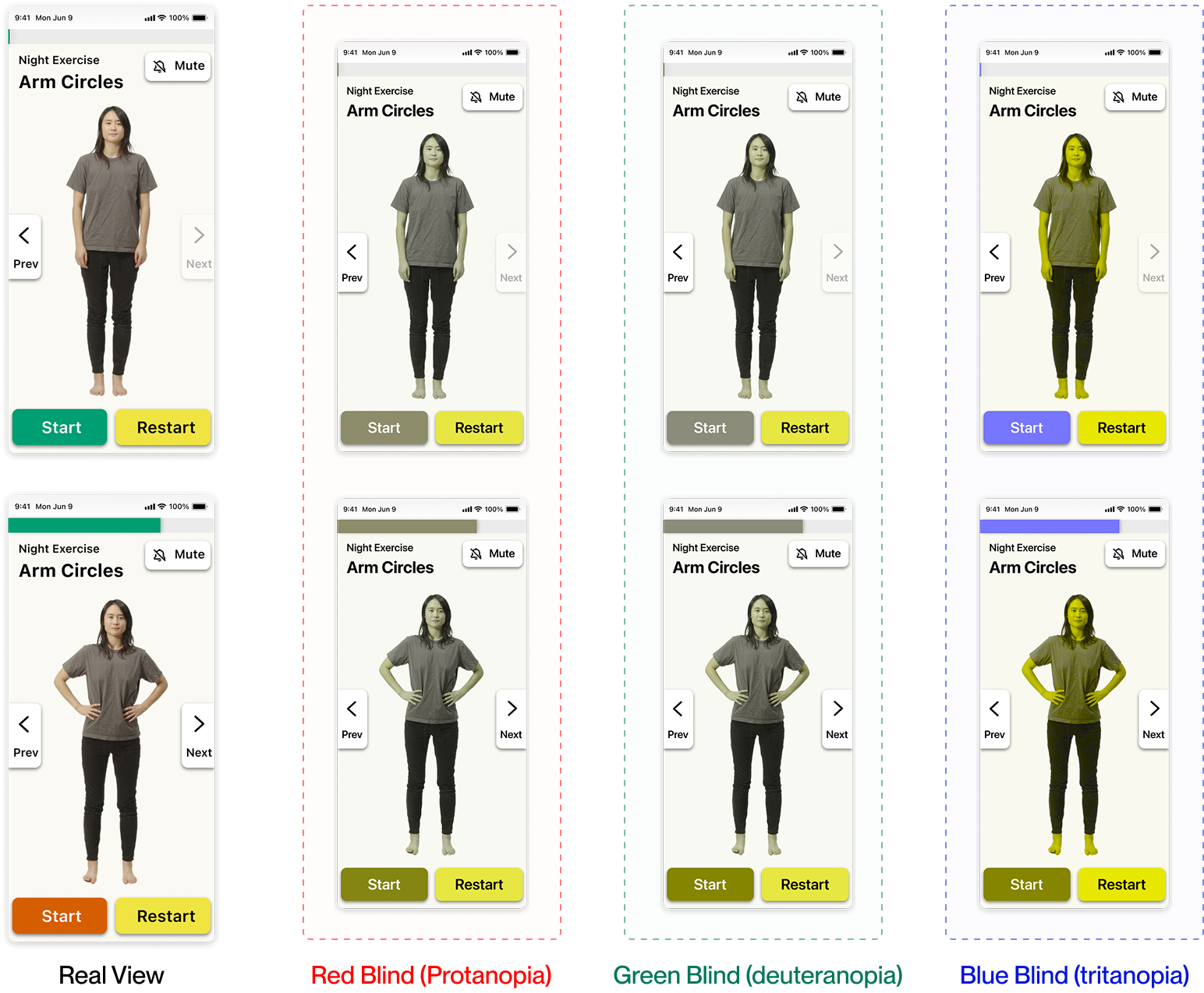
This is the result of testing the actual screen shown to color-blind people through color-blind simulation.
04. Design Iteraction
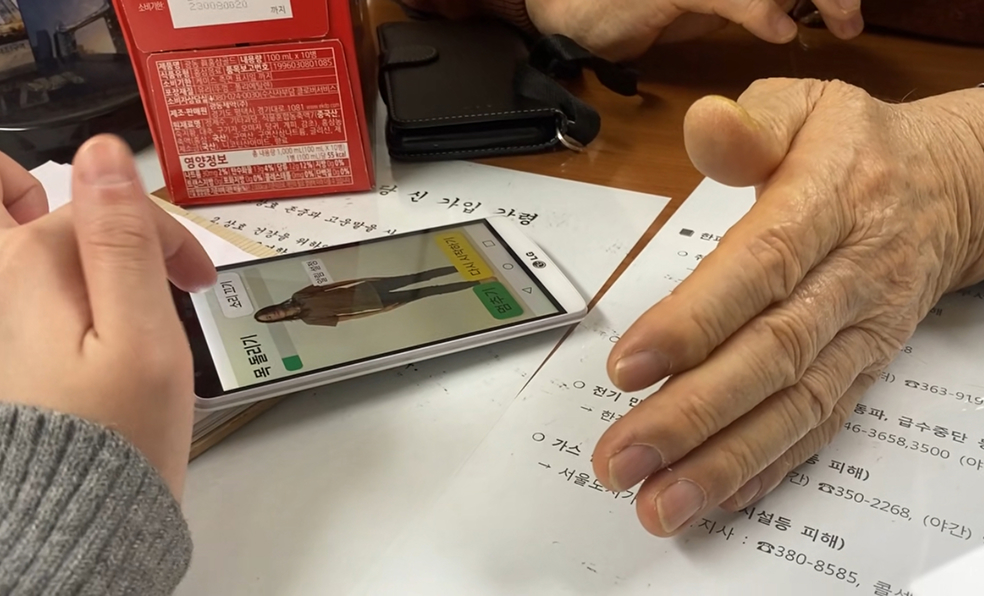
After applying color-blind friendly colors and conducting QA sessions with actual elderly users, we discovered that emphasizing the importance of buttons to be pressed was more critical than color alone. As a result, we retained color only for the most frequently used button and removed confusing colors elsewhere, significantly improving readability.

This color chart represents the colors used in the UI.
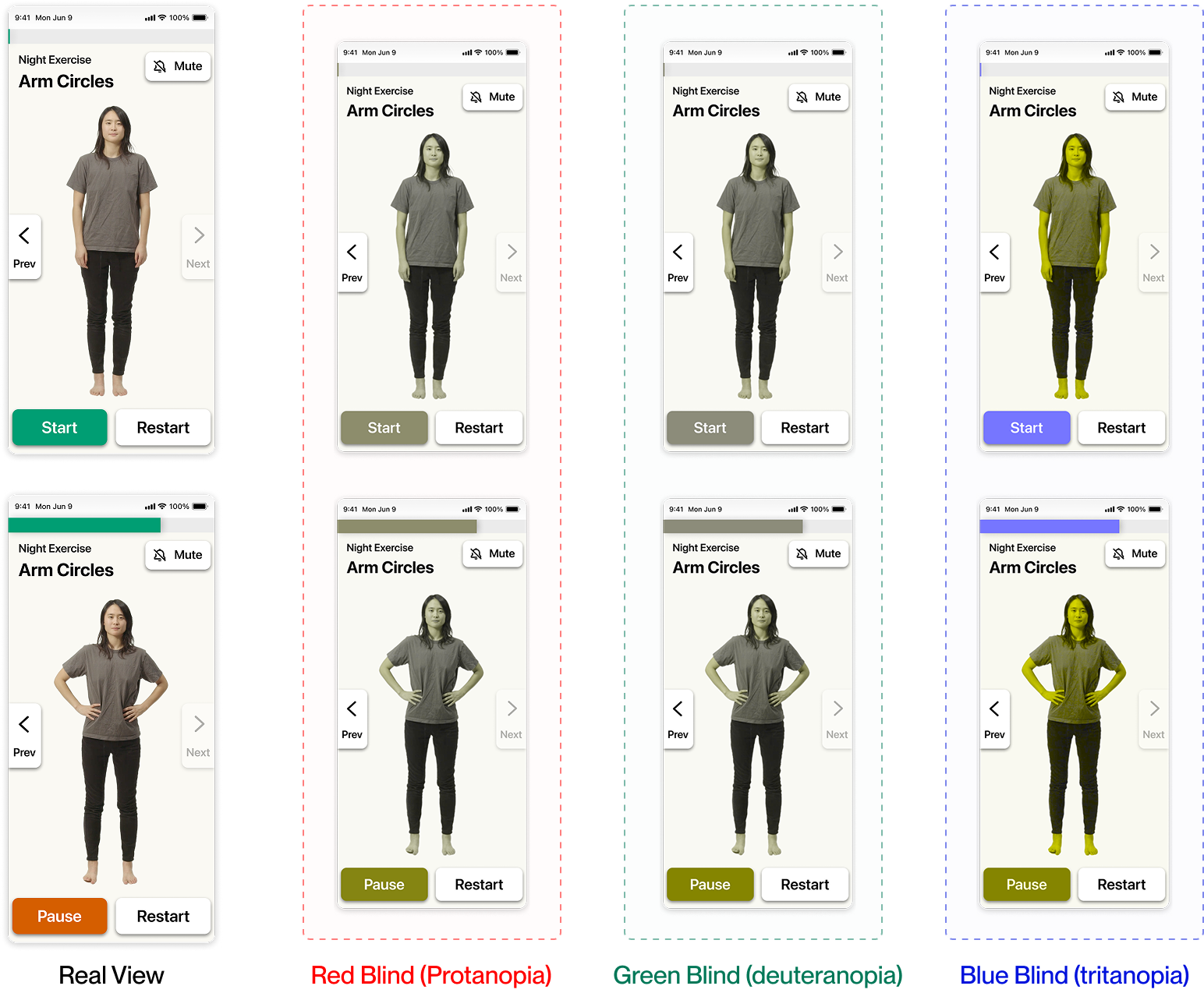
This is the result of testing the actual screen shown to color-blind people through color-blind simulation.
Silver Bell: Mobile Exercise for Hongyeon-gil Seniors

01. Notification-first start
Notifications are sent at scheduled times, and exercise begins immediately when the user taps the notification.
02. Time-based routine planning (3 sessions)
Notifications scheduled at morning (10 AM), lunch (2 PM), and evening (8 PM) to match users' daily routines.
03. Familiar, low-intensity exercise routines
Composed of familiar, low-intensity movements to reduce the burden of learning new exercises.
04. Barrier-free UI
Color palette adjusted for color blindness accessibility (red shifted to orange, green to teal).
Silver Bell: Mobile Exercise for Hongyeon-gil Seniors
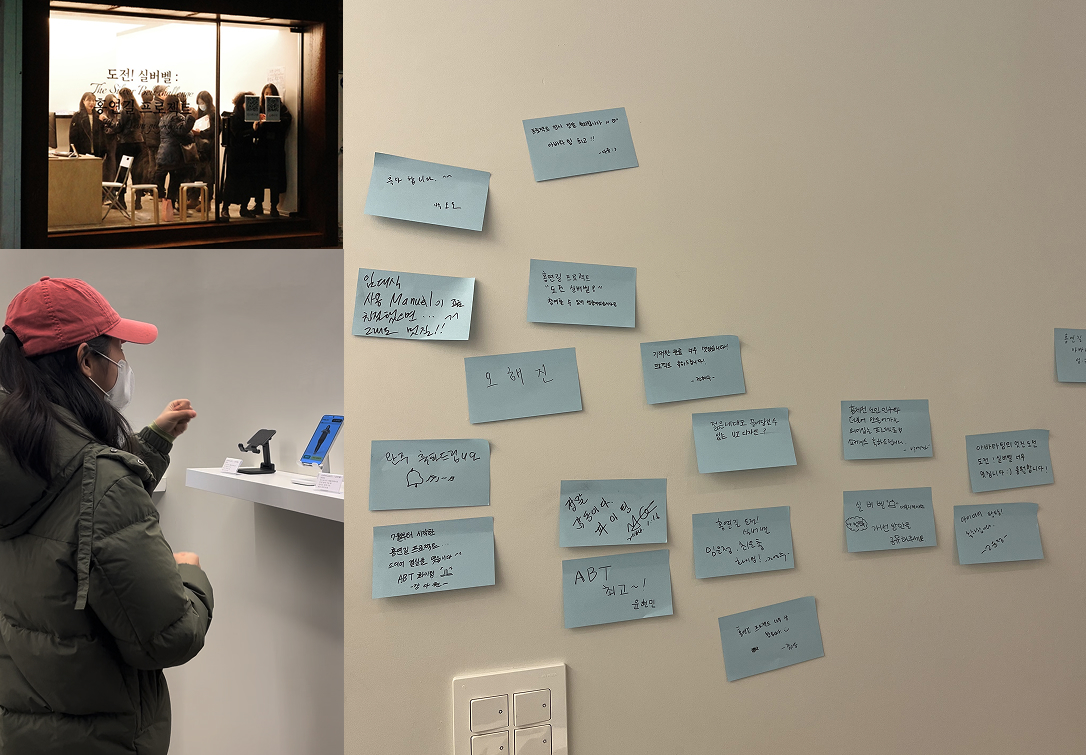
The Silver Bell Challenge : Hong Yeon-gil project showcase, tentothen, 2024
Interaction Is Notification-Driven, Not Exploratory
Older adults primarily used their phones to respond to alerts and notifications rather than browsing menus or exploring features. Interfaces felt most comfortable when important information was immediately visible, supported by bold typography and high-contrast primary actions. As a result, designs that surfaced critical actions upfront reduced hesitation and the need for navigation or discovery.
Setup and Onboarding Are the Real Barriers
Initial installation and setup—not feature complexity—emerged as the largest obstacle to adoption. Many participants struggled to download and configure the app independently, even before engaging with its core functionality. This showed that onboarding and access, more than feature depth, determined whether the system could be used at all in real-world contexts.