2026 Samsung Design Membership
The online website for 2026 Samsung Design Membership
06.2026 - 08.2026 / Design Engineering, Frontend Development / Samsung Electronics
Overview
2026 MEP Online Exibition <everyelse>
Process
How I worked with designers
2026 is a year in which the barrier to entry for AI keeps getting lower, bringing significant shifts to the boundaries between designers' and developers' work. While building the MEP exhibition website, I tried breaking away from the traditional design/development collaboration model and instead experimented with a way of working where designer and developer crossed into each other's territory. Below, I've documented specific moments from that process.
The 2026 SDM website includes a participatory section called Our Gaze. In line with the design concept, the designers wanted a motion that conveyed the sensation of being drawn into space, and we decided to implement it with three.js. However, because the exhibition preparation schedule was tight and the design team was short-staffed, I ended up having to build it myself from 2D sketches alone, without any 3D models to work from.
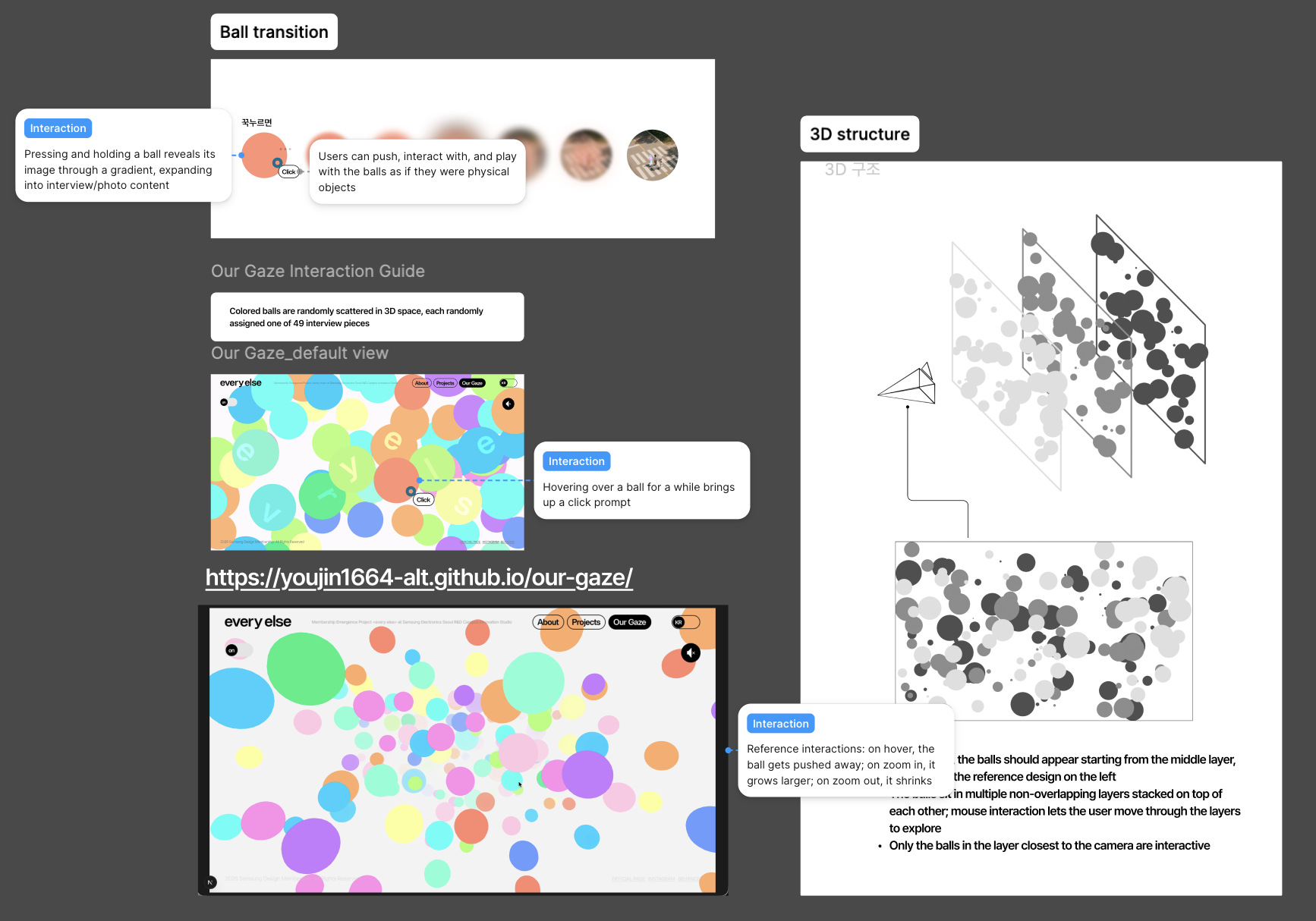
What I first received was a webpage the designers had put together through vibe coding. The zoom in/out range was very narrow, so the sense of being pulled in was only realised at a preview level. I needed to raise the overall polish by adding zoom in/out, hover motion, and click-triggered interactions, while the designers, at the same time, wanted to push that "pulled-in" sensation even further. The number of spheres visible on screen at different zoom levels was another condition that mattered.
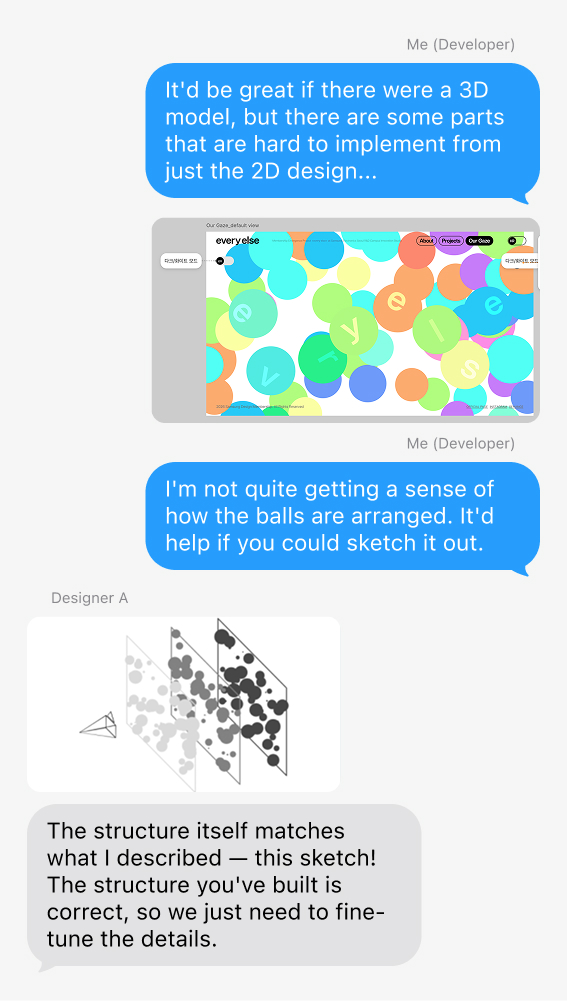
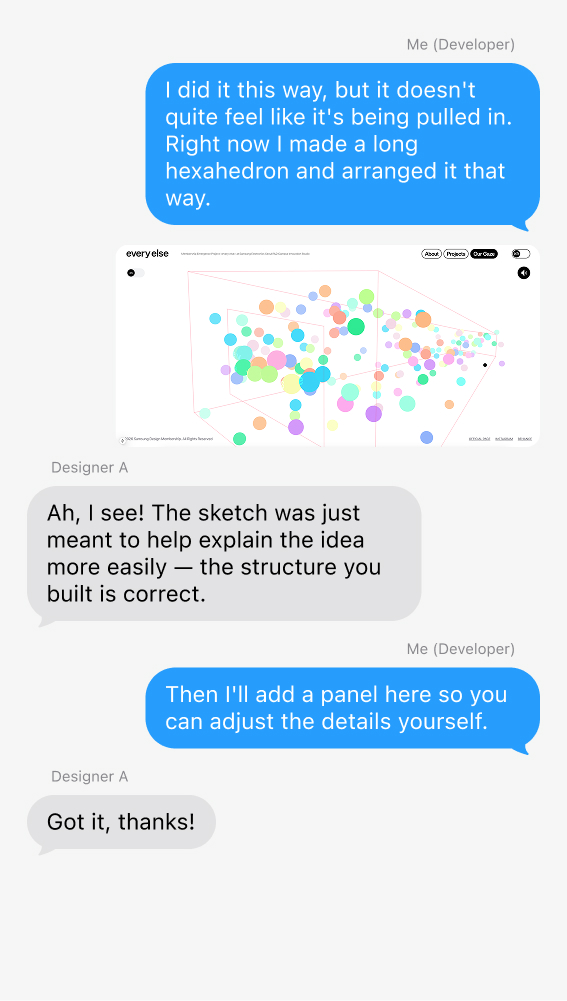
The problem was that it was hard to judge, from the vibe-coded webpage alone, how the particles should actually be arranged in 3D space. So I asked the designers to sketch out the direction they had in mind, and they produced several candidate shapes for the pulled-in effect. I worked through each candidate in turn, revising continuously, and eventually proposed an elongated cuboid. In this structure, the spheres stayed evenly distributed across the screen during zoom in/out, and the sense of being drawn inward was still preserved.
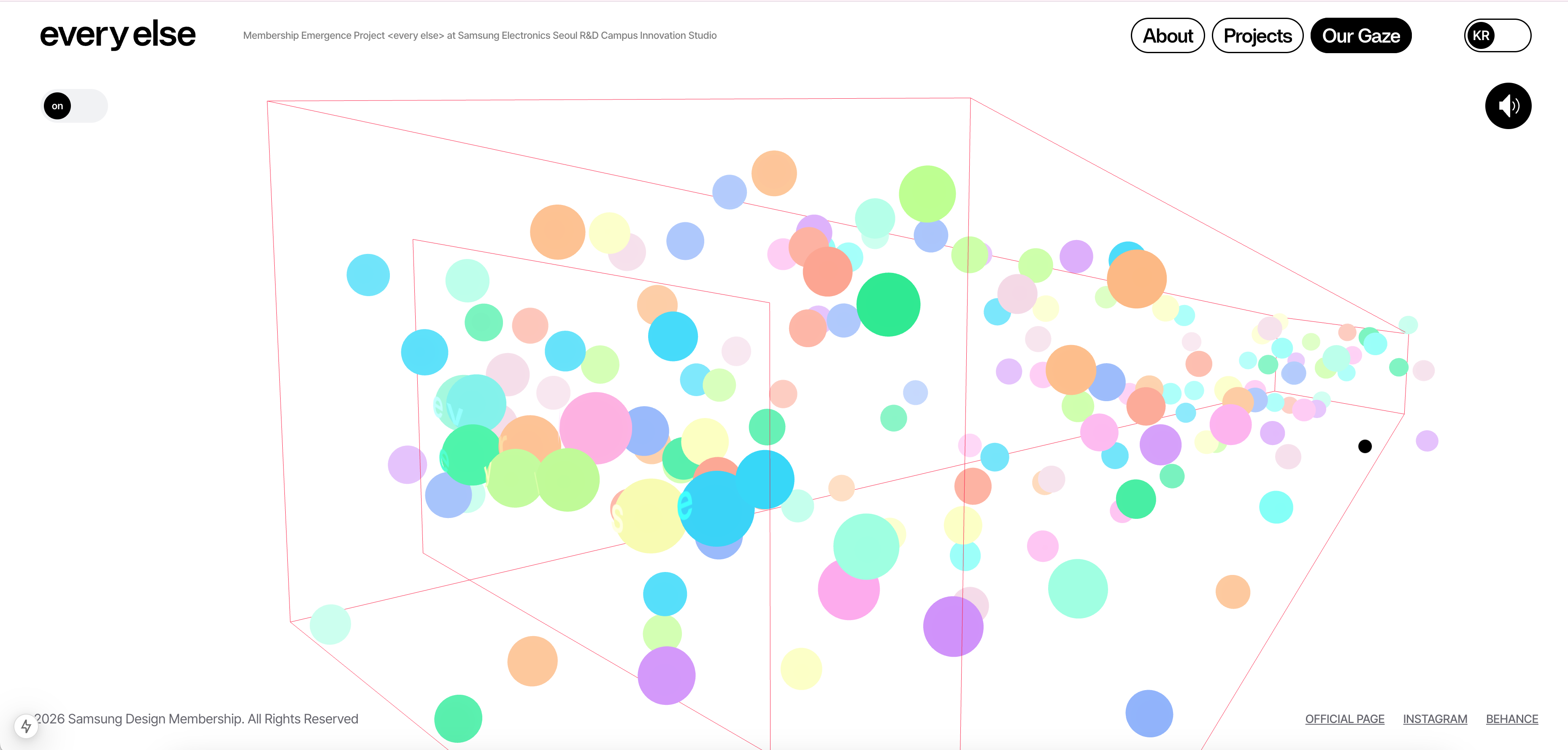
Once the shape was finalised, the next step was defining a set of adjustable parameters (the depth and range of the particle space, the degree of pull toward the centre, the minimum and maximum zoom distance, etc.), then adding further variables the designers requested on top of these. I established minimum and maximum bounds that would not strain performance on web and mobile before handing the panel over, and the designers finalised the actual parameter values themselves from there. In this way, we arrived at a result that satisfied several constraints at once: the pulled-in sensation, uniform density, and performance.




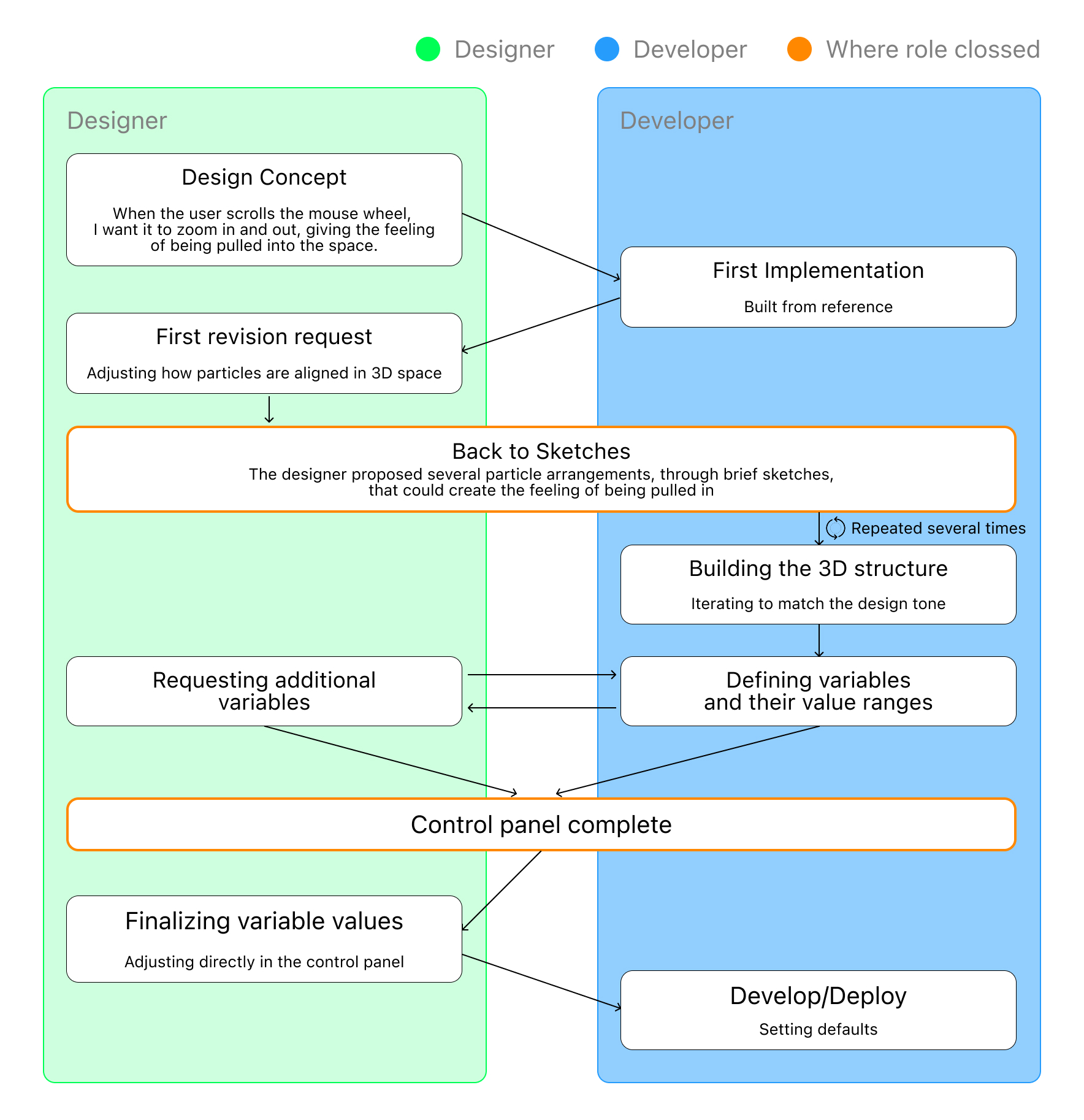
We also applied this same collaborative process when building the invitation page and the coming soon page. I found this meaningful, since it let us achieve a highly polished design while reducing the workload for both designers and developers. It also gave me a chance to establish my own approach to communicating with designers when implementing 3D on the web with three.js. Below is a diagram summarising this collaborative process. It reflects our thinking on how designers and developers, while crossing into each other's territory, could communicate efficiently.